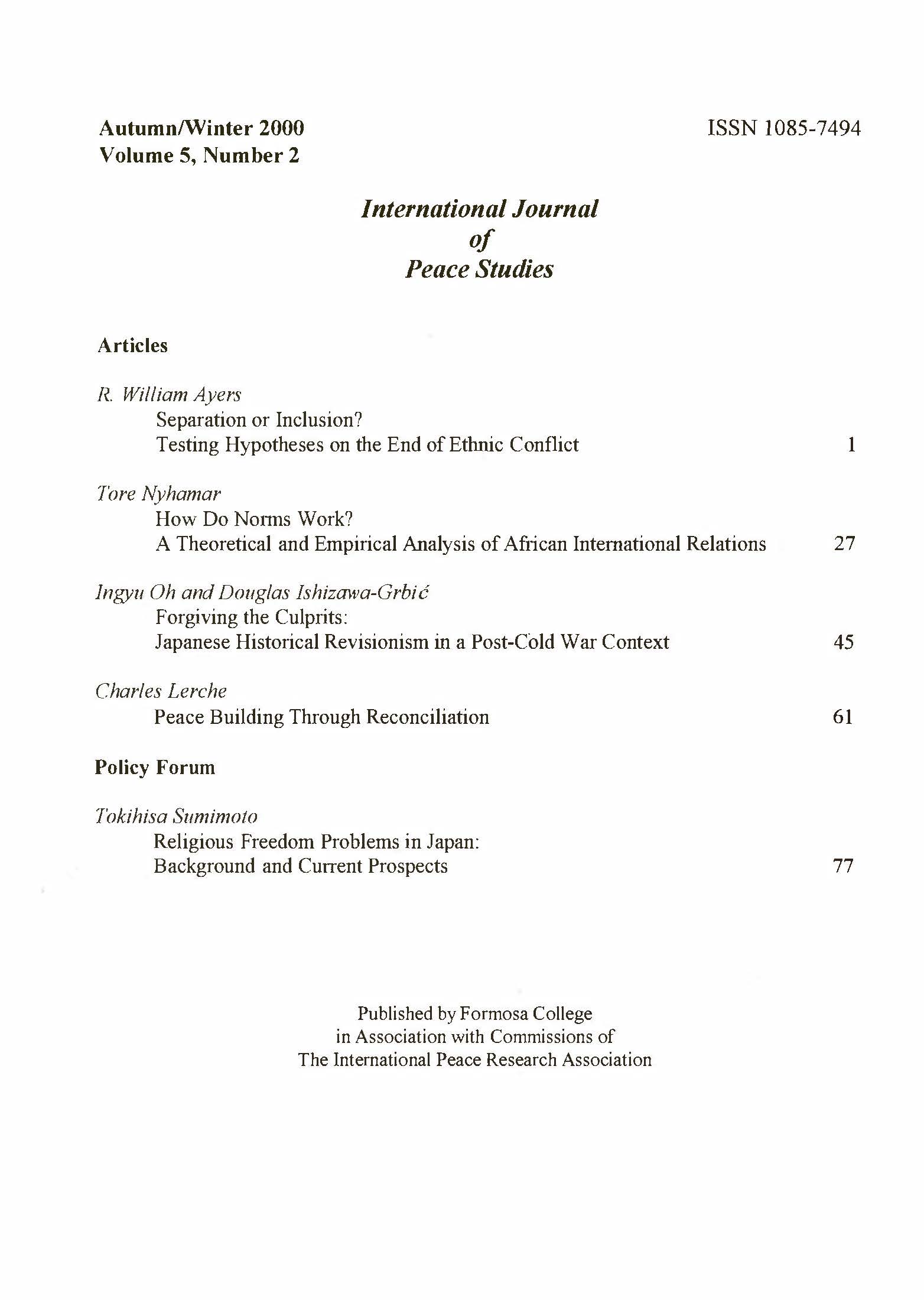
How Do Norms Work?
A Theoretical and Empirical Analysis of African International Relations
Abstract
The article discusses what constitutes a norm in international relations, and how we can establish <�mpirically lhal norms exert causal influence on the foreign policy of African states. The empirical section of the article explores how norms work together with rationality in the Angolan war in 1975 and the Kenyan-Ugandan war of 1979. In both cases norms did play a part by entering into the actors' calculations, but norms alone were not able to fully explain the behavior of the actors concerned. Instead, it is concluded, the challenge is to find the particular mix of rationality and norms in each concrete case. In these wars, the main way for norms to have causal influence was as a constraint on rationality. Another theoretical finding is that norms quickly loose their constraining force for all actors when one party does not adhere to them. However, lhe article concludes that adherence to norms is contingent upon the behavior of others in the conflict itself but not behavior in other con11icts. Finally, one should be careful not to overestimate the causal importance of norms in explaining behavior as there are often competing norms and the actors will choose the one most conducive to their self-interest when they act.